Goodlife Health Clubs
Replacing lock-in anxiety
with sign-up confidence
Goodlife Health Clubs is one of Australia's largest gym chains, with hundreds of thousands of members across dozens of locations. I redesigned their membership sign-up experience as part of a new website build, with the goal of reducing confusion, improving trust, and modernising a flow that no longer reflected how people wanted to commit to a membership.
Company
Goodlife Health Clubs
Product
Membership sign-up flow
Year
2020
Role
Sole product designer
Scope
End-to-end membership sign-up flow
Collaboration
Engineering team and client stakeholders
The problem
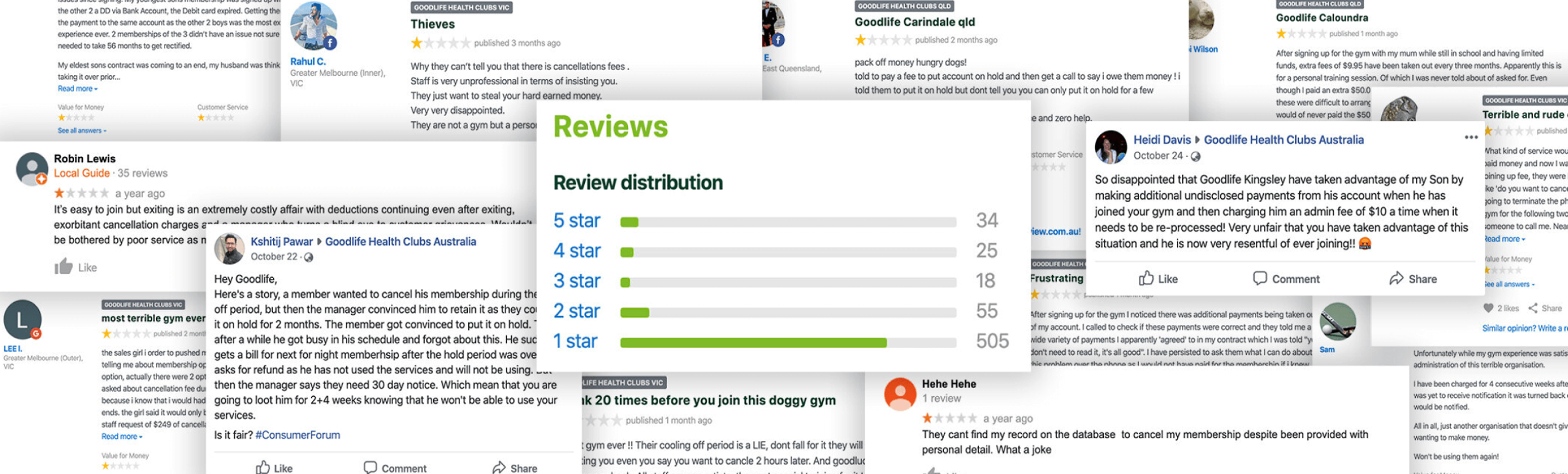
Gym memberships are notoriously difficult to understand. At Goodlife, this showed up clearly in customer feedback. People weren't frustrated by the gyms or the staff. They were frustrated by contracts, hidden fees, and unclear cancellation terms. The existing sign-up experience reinforced that mistrust.
From a business perspective, the flow was also dated and brittle. It relied on patterns that pushed people through checkout without helping them feel confident. The goal wasn't just higher conversion. I wanted the experience to feel transparent, so that people who signed up actually felt good about what they'd agreed to.
My role
I was the sole designer on this project. I worked closely with an engineering team and collaborated with client stakeholders, but I owned the experience design and the decisions that shaped it. Day-to-day product decisions were made in close partnership with the engineering manager.
The moment that stayed with me was when the flow we'd designed started becoming a problem for the engineering team. I'd sold the developer on the vision early. A highly customised checkout experience that broke from BigCommerce defaults. He was enthusiastic and said we could do it. What neither of us had pushed on hard enough was what that customisation would actually cost in time. By the time that became clear, we were already deep in build. The project shipped late, and some of that landed on me.
What I'd do differently is have that honest conversation about risk much earlier, and bring the developer into the design process as a real partner rather than someone I was presenting a completed vision to. There was a version of this flow that was 80% as good and 50% as complex. I didn't give us the space to find it.
What I learned early
A review of public feedback and social mentions made one thing clear: most complaints were about membership structure, pricing clarity, and cancellation. People felt locked into agreements they didn't fully understand.
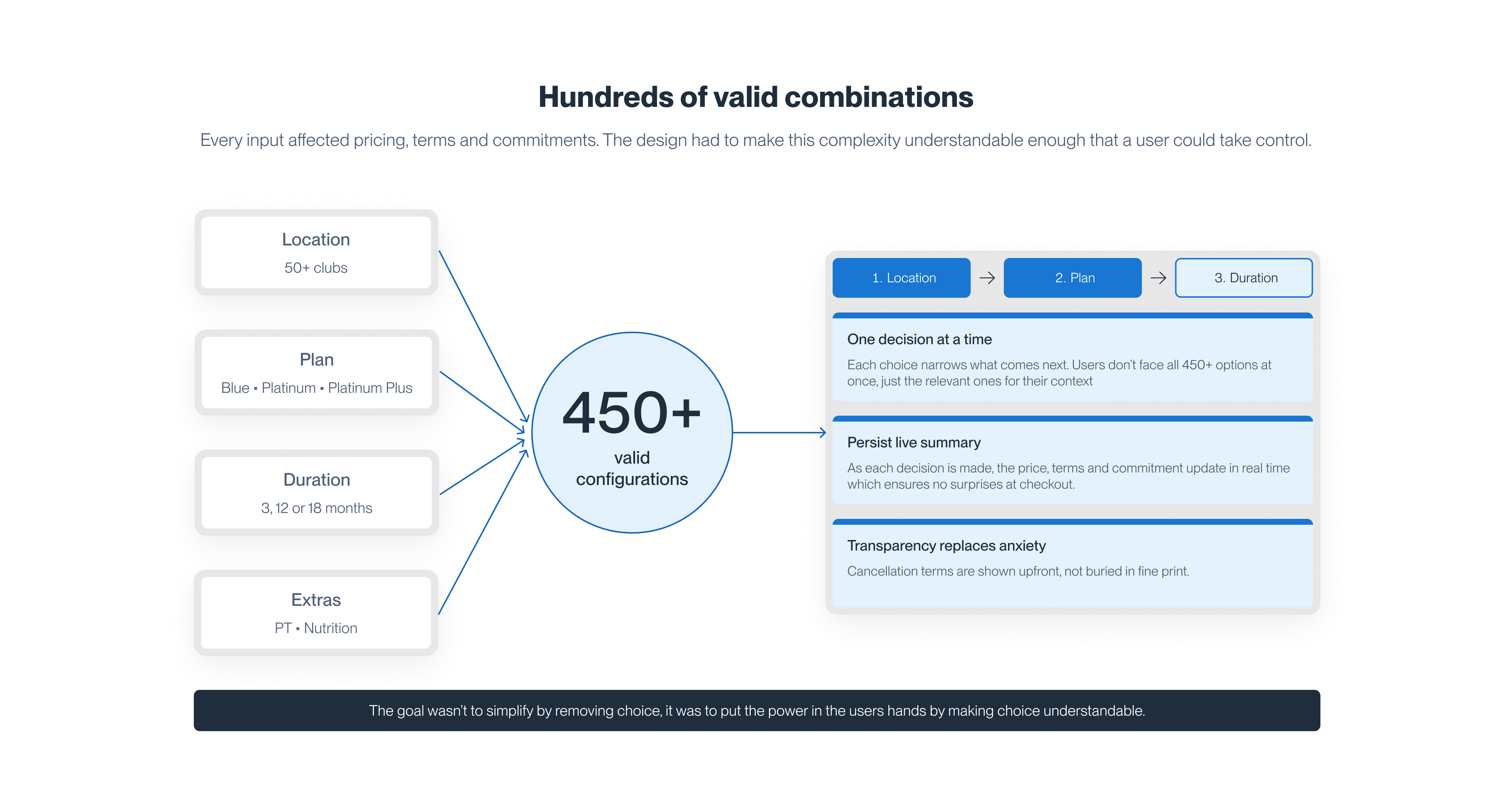
Looking at competitors reinforced the pattern. Most gyms prioritised lead capture over clarity, hiding meaningful details until late in the process. The opportunity wasn't to simplify by removing choice — it was to make choice understandable. Underneath, every decision added complexity: location, membership length, deposit amount, and location-specific extras all affected pricing and terms, creating hundreds of valid membership configurations that needed to remain accurate, consistent, and explainable.
The core design decision
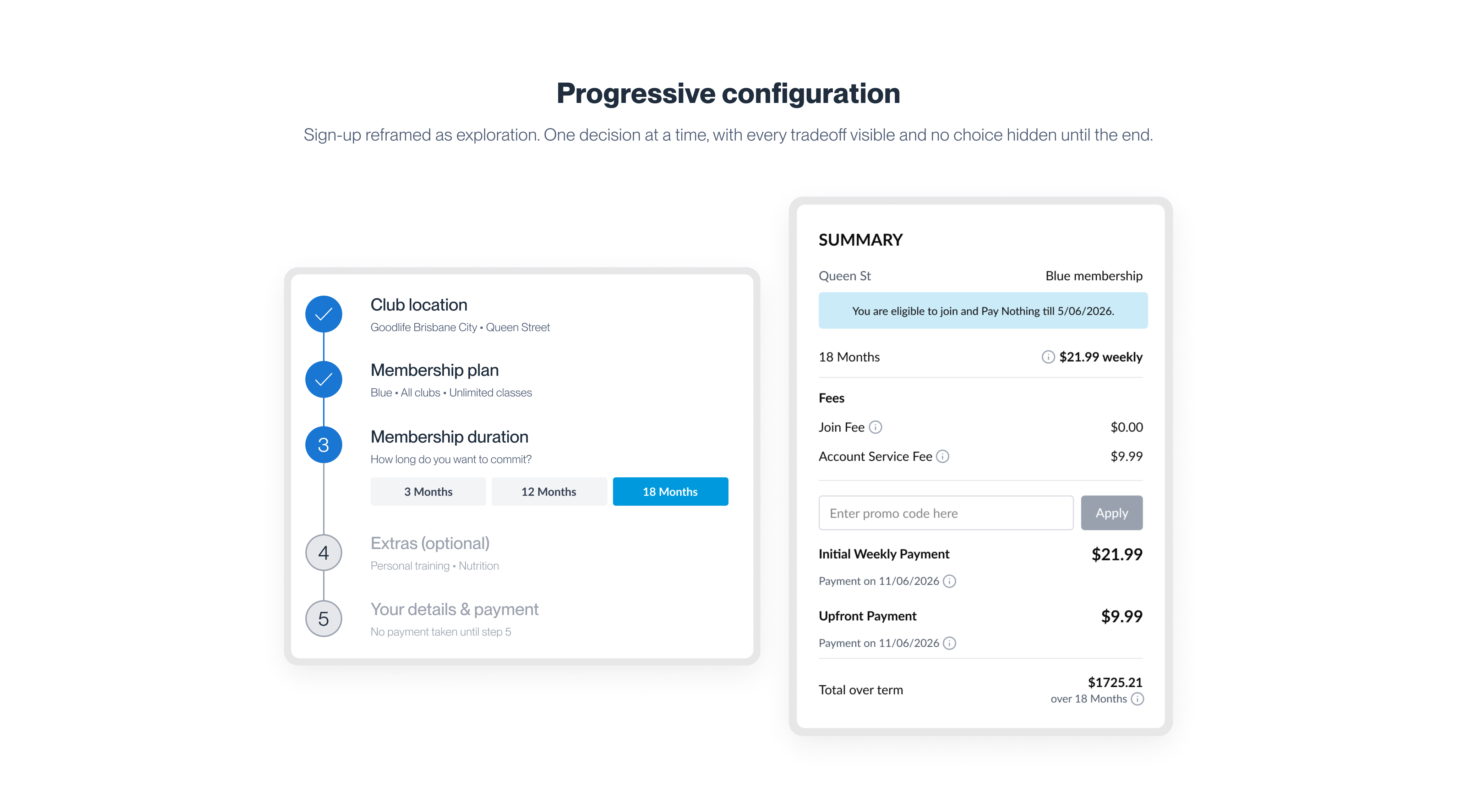
The most important decision was to treat sign-up as an exploration and configuration process, not a traditional checkout.
I designed a progressive flow where users made one decision at a time, each shaping what they saw next. I removed the standard cart step entirely and replaced it with a persistent summary that updated in real time as users configured their membership. As people adjusted membership length, deposits, or optional features, the summary immediately reflected the impact on pricing and commitments.
The goal wasn't to push people through. It was to make sure that by the time someone reached payment, they already understood exactly what they were signing up for.
Working within constraints
The experience was built on BigCommerce. Using a SaaS platform gave us reliable infrastructure and faster delivery, but the level of customisation required to support the desired flow introduced complexity. Early on, we extended default patterns to support the interaction model we believed was right.
As development progressed, it became clear that some of these decisions introduced instability and additional engineering effort. In hindsight, I would be more selective about where to customise versus where to adapt the design to platform constraints. Long-term maintainability would take priority over perfect alignment with an idealised flow.
Outcome
The redesigned sign-up flow shipped largely as designed. Users responded positively to the increased clarity and sense of control. Stakeholders felt confident signing off on the experience, and the prototype reduced back-and-forth during development by making the logic explicit early.
What stayed with me most was how much people were already carrying before they clicked the first button. The frustration wasn't with the gym. It was the anxiety of committing to something they didn't fully understand. Designing for that emotional state turned out to be a better brief than "increase conversion."
What I'd carry forward
This was one of my early projects after switching to product design. I was anxious about it, and that anxiety made me very thorough. I spent a long time arriving at a solution I felt certain about. In hindsight, that certainty closed off some room for partnership. I could have gone to the developers earlier, worked through the constraints together, and found a version that shipped on time without giving up much. The thoroughness wasn't wasted. It just came a little too late in the process to be fully useful.
The bigger lesson: understanding what users are feeling before they start is as important as understanding what they need to do. The best brief here wasn't the business goal. It was the emotional one.
I'm still proud of this one. People were angry and felt manipulated by a membership process they didn't fully understand. Finding a way to put control back in their hands, and borrowing from configuration patterns in other industries to do it, felt like the right instinct.
Let's talk
Seen something that resonates? I'm open to the right opportunity, a collaboration, or a good conversation about design.